This guide covers how 5-Axis machining works, what machine configurations exist, where it gets used, and how to evaluate whether it fits your production needs.
What Is 5-Axis CNC Machining?
5-Axis CNC machining means the cutting tool can move across five independent axes simultaneously: the three linear axes (X, Y, and Z) and two rotary axes. That combination lets the tool approach the workpiece from virtually any angle in a single setup, making it capable of producing geometry that would require multiple repositions on a three-axis machine. The practical result is fewer setups, better accuracy, and access to features that three-axis simply cannot reach.
How CNC Machine Axes Work
Linear Axes: X, Y, and Z
X moves the tool left and right, Y front to back, Z up and down. A three-axis machine can reach any point on the top face of a part but only from one orientation. Anything on a side face, angled surface, or undercut requires repositioning.
Rotary Axes: A, B, and C
Rotary axes add tilt and rotation. A rotates around X, B around Y, C around Z. A 5-Axis machine uses two of these three alongside the linear axes, letting the tool approach the workpiece from compound angles that three-axis cannot reach.
How 5-Axis CNC Machining Works
Moving the Cutting Tool and Workpiece
The rotary motion can come from moving the tool, the workpiece, or both, depending on configuration. Head-head machines put both rotary axes in the spindle. Table-table machines put both in the table. Head-table machines split one axis between each. Each approach has different implications for part size, rigidity, and programming complexity.
 Machining Complex Angles and Contours
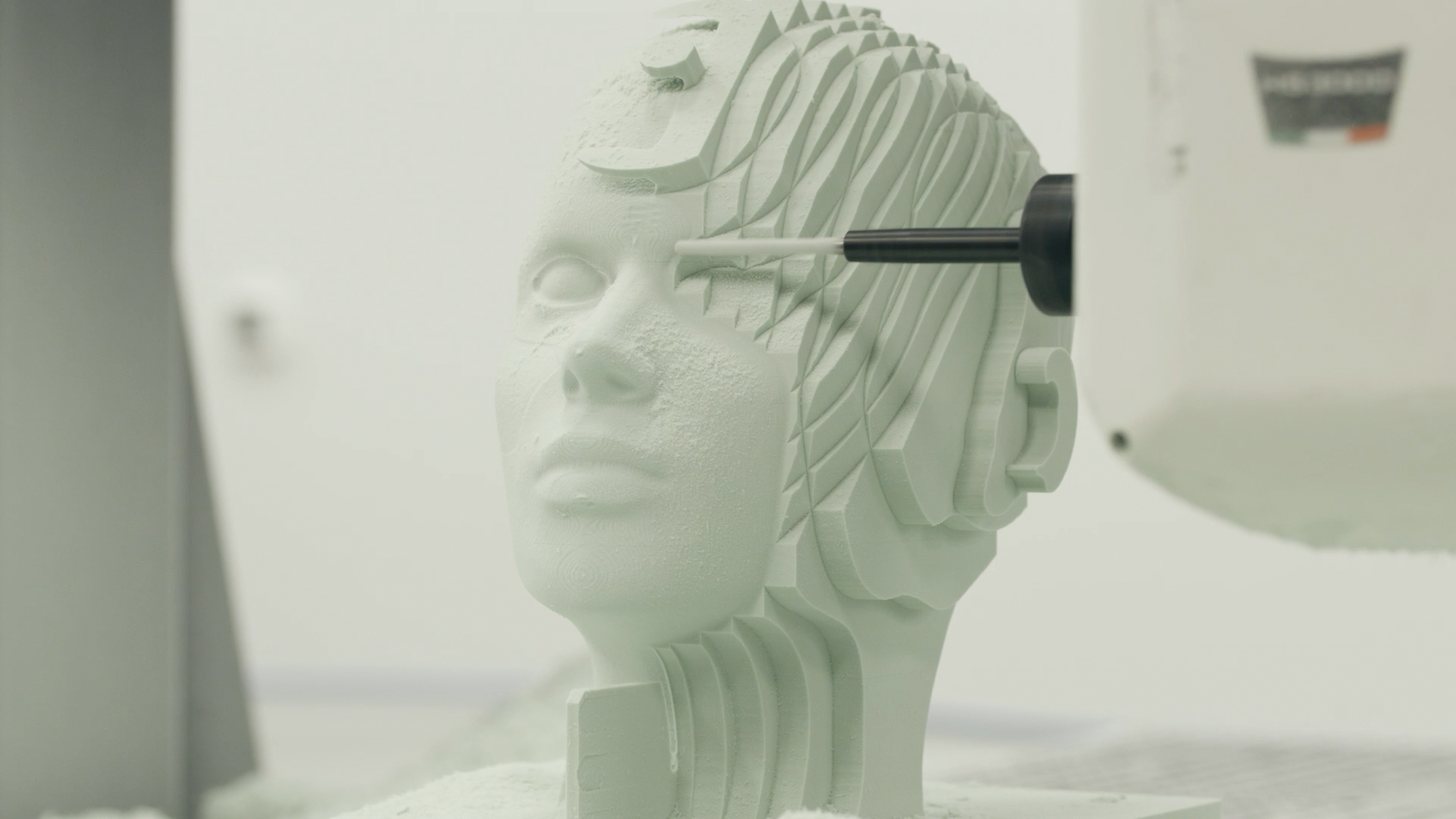
The real capability of 5-Axis is keeping the cutting tool at the optimal angle relative to the workpiece surface throughout the cut. This is what makes turbine blades, impellers, complex mold cavities, and anatomical implants achievable. On three-axis, those geometries either cannot be reached or require tool angle compromises that hurt surface finish and tool life.
Types of 5-Axis CNC Machines
Trunnion-Style 5-Axis CNC Machines
The table tilts and rotates, carrying the workpiece through both rotary axes while the spindle moves linearly. Common in job shops and production environments for its rigidity and broad part size range.
Swivel-Rotate-Style 5-Axis CNC Machines
Both rotary axes are in the spindle head with the workpiece on a fixed table. Works well for large, heavy parts that would be difficult to move through a trunnion's rotary range.
Head-Head 5-Axis Machines
Both rotary axes in the spindle head, fixed table. Used for very large parts in aerospace and heavy industrial work where moving the workpiece is not practical.
Head-Table 5 Axis Machines
One rotary axis in the head, one in the table. A hybrid that balances rigidity and accessibility, common in general machining centers handling mixed part types.
Table-Table 5 Axis Machines
Both rotary axes in the table, spindle moves linearly only. The most common design in mid-range 5-Axis machining centers. Good rigidity, predictable programming behavior, and a proven track record make it the default starting point for many shops.
Indexed vs. Simultaneous 5-Axis Machining
Indexed 5-Axis Machining
Also called 3+2, indexed machining uses the rotary axes to position the workpiece at a fixed angle, then machines with the linear axes. Simpler to program and sufficient for a large percentage of complex parts. Many shops running 5-Axis work are primarily doing 3+2.
Simultaneous 5-Axis Machining
All 5-Axis move at the same time during cutting. Required for turbine blades, impellers, and complex contoured surfaces where maintaining a constant tool-to-surface angle across flowing 3D geometry is necessary. Programming is significantly more complex, but for the right parts there is no substitute.
Common Applications of 5 Axis CNC Machining
Aerospace Components
Turbine blades, impellers, structural airframe components, and complex brackets in titanium and high-temperature alloys are the defining 5-Axis applications. Geometric complexity and tight tolerances make 5-Axis the standard in aerospace production.
Automotive Parts
Cylinder heads, intake manifolds, transmission components, and mold tooling for body panels. Complex port geometries in particular benefit from maintaining optimal tool angle throughout the cut.
Medical Devices and Implants
Bone implants, dental components, and surgical instruments require complex geometry, tight tolerances, and biocompatible materials. Anatomical titanium and cobalt-chrome implants are a primary 5-Axis medical application.
Mold and Die Making
Injection mold cavities and forming dies with undercuts and draft angles require 5-Axis access. The right tool angle produces better surface finish and longer tool life than three-axis compromises allow.
Complex Prototypes
Prototypes evaluated against production intent benefit from 5-Axis accuracy and surface quality, producing parts that are functionally representative in ways three-axis work often cannot match.
Precision Industrial Parts
Pump impellers, compressor wheels, and fluid handling components with complex internal geometry. Any part with features on multiple non-parallel faces is a candidate.
Benefits of 5 Axis CNC Machining
Greater Part Complexity
5-Axis can reach surfaces and produce features that are physically inaccessible to three-axis in a single setup. This is about making parts that three-axis cannot make, not just making them faster.
Fewer Setups
Parts needing multiple setups on three-axis can often be completed in one 5-Axis setup. Fewer setups mean less accumulated error, faster cycle times, and less operator time per part.
Improved Accuracy and Repeatability
Single-setup machining removes positioning error that builds up with each repositioning. For parts with tight tolerances across multiple faces, this shows up directly in inspection results.
Better Surface Finish
Maintaining optimal tool engagement angle across a complex surface means better scallop height control, more consistent chip load, and better finish than fixed-orientation work. The difference is visible and measurable.
Faster Production for Complex Parts
5-Axis is not faster on simple parts. On complex geometry requiring multiple three-axis setups, the total time including setup, repositioning, and inspection is typically lower with 5-Axis.
Ability to Machine Hard-to-Reach Features
Deep cavities, undercuts, angled holes, and features on inclined surfaces are accessible with 5-Axis in ways that are not practical on three-axis. This drives adoption in mold making, aerospace, and medical manufacturing.
Limitations of 5 Axis CNC Machining
Higher Machine and Setup Costs
5-Axis machines carry a higher price than three-axis of comparable size. Additional mechanical complexity, rotary axis precision requirements, and programming overhead all contribute.
More Complex Programming
5-Axis CAM programming, especially simultaneous, is substantially more involved than three-axis work. Collision avoidance, tool axis control, and engagement angle management require more sophisticated CAM knowledge and longer programming time.
Skilled Operators May Be Required
Running 5-Axis well demands more from operators. Setup, workholding design, and process monitoring are all more involved. Plan for the training investment alongside the machine investment.
Not Necessary for Every Part
Most production machining can be handled on three-axis. 5-Axis adds cost and complexity that is only justified when the parts genuinely require it.
When Should You Use 5-Axis CNC Machining?
When Parts Have Complex Geometry
Features on multiple non-parallel faces, compound curved surfaces, undercuts, or geometry requiring the tool to approach from multiple directions. If three-axis cannot access it cleanly, 5-Axis is the answer.
 When Tight Tolerances Are Required
Parts holding tight tolerances across multiple faces benefit from single-setup machining. Every repositioning introduces error; 5-Axis eliminates that source of variation.
When Reducing Setups Matters
If a part currently requires three or four setups and the accumulated error or cycle time is affecting quality or throughput, 5-Axis is worth evaluating seriously.
When Surface Finish Is Important
Complex 3D surfaces needing quality finish without extensive hand work are consistently better produced on 5-Axis. The optimal tool engagement angle it can maintain across a surface reduces the manual finishing required.
Is 5 Axis CNC Machining Better Than Higher-Axis Machining?
Higher-axis configurations serve specific applications in advanced manufacturing, adding capabilities like combined mill-turn or additional positioning axes. For the vast majority of complex part work, 5-Axis covers the requirement. The right axis count is always the one that matches the work, not the highest number available.
How to Choose the Right CNC Axis Configuration
Part Complexity
Start with the actual geometry of the parts you need to produce. If three-axis can access all necessary features in a manageable number of setups, three-axis is the right machine.
Material and Tolerance Requirements
Higher-tolerance work in difficult materials benefits more from single-setup 5-Axis machining. Softer tolerances in easier materials may be adequately served by three-axis with repositioning.
Production Volume
High-volume production of complex parts favors 5-Axis. Low-volume prototype and short-run work may be better served by three-axis with additional setups, where setup time is a smaller fraction of total job time.
Budget and Long-Term Needs
Buying 5-Axis ahead of the work that justifies it is expensive. So is losing jobs because your machine cannot hold tolerances or reach the geometry the work requires. The right timing depends on the work you are winning and the work you are turning away.
Conclusion: Is 5-Axis CNC Machining Right for Your Application?
5-Axis is not universally the better machine. It is the better machine for work that requires it, and it adds cost and complexity that is not justified for work that does not. The decision comes down to your part geometry, tolerance requirements, and whether the capability gain justifies the investment in machine, software, and training. For shops producing complex aerospace, medical, automotive, or mold work, 5-Axis is often not optional at a serious production level. Contact the Laguna Tools team to discuss which axis configuration fits your actual production needs.