Wood is one of the most rewarding materials to mill on a CNC router, and one of the most variable. Two boards of the same species can behave differently depending on grain direction, moisture content, and natural defects. Getting consistently clean results requires understanding not just how to set up a cut, but why the material responds the way it does. Get those fundamentals right, and wood milling becomes one of the most efficient production processes a CNC router can run.
How Does CNC Milling Work for Wood?
CNC milling uses a computer-controlled spindle to move a rotating cutting tool along a programmed path, removing material to produce a finished shape. For wood, that means profiling, pocketing, carving, and joinery cuts that would take significantly longer to produce by hand and that repeat with exact precision across every part in a run.
Wood milling differs from metal milling in important ways. Wood cuts faster, but its natural variation, grain, knots, and moisture content, means that parameters working perfectly on one board may need adjustment on another. The goal is developing a reliable process for the specific wood and application you are running, not copying a generic settings table.
Choosing the Right Wood for CNC Milling
Not all wood machines equally well. Species, structure, and how the material was dried and stored all affect how cleanly it cuts and how stable it stays on the machine.
Hardwoods
Oak, maple, walnut, cherry, and ash produce excellent results on a CNC router. Their density and tight grain support clean edges and fine detail work, and they hold tolerances well across a job. The trade-off is that hardwoods require sharper tooling and closer attention to bit condition. Dense species like hard maple and hickory wear tooling faster than most.

Softwoods
Pine, cedar, and fir machine quickly with less tool wear, but the softer fibers are more prone to tearout when the bit is dull or the feed rate is too low. Fuzzy edges and fiber pullout are the most common surface quality problems in softwood milling, and both are largely preventable with sharp tooling and appropriate chip load.
Engineered Woods
MDF, plywood, and particleboard machine consistently because their uniform composition eliminates grain direction and natural defects. MDF cuts with exceptional cleanliness and holds detail well, making it reliable for painted components and cabinet doors. The downside is dust: engineered wood products generate fine particulate at high volume, and proper dust collection is non-negotiable when running them regularly.
Wood Properties That Affect CNC Milling
Understanding how wood behaves as a material is what separates operators who get consistent results from those chasing surface quality problems. Three properties affect almost every aspect of the milling process.
Grain Size and Direction
Wood grain runs longitudinally through the board, and how the cutter engages it determines edge quality. Cutting with the grain generally produces cleaner results than cutting against it. End grain is significantly harder and more abrasive than face grain in the same species, which affects tool wear and surface finish. Designing toolpaths to take advantage of favorable grain direction where possible is one of the simplest ways to improve output quality.
Moisture Content
Wood moves as it gains and loses moisture. Stock intended for CNC milling should be dried to a moisture content appropriate for its end use environment, typically 6 to 8 percent for interior applications. Wood that is too wet machines poorly and produces torn surfaces. Most shops condition lumber before milling and store it in climate-controlled spaces to maintain consistency.
Knots and Natural Defects
Knots are significantly harder and denser than the surrounding wood, and a cutter working efficiently through clear lumber will experience a sudden resistance increase when it hits one. This can cause deflection and surface quality changes at the knot. For production work where appearance matters, selecting clear stock avoids these problems. Natural checks and voids are also worth identifying before a job since unsupported areas can vibrate and voids can catch a cutter unexpectedly.
Choosing CNC Cutting Tools for Wood
Tool selection influences cut quality as much as feeds and speeds. The right bit depends on the operation, the material, and the finish requirement.
Types of Cutting Tools
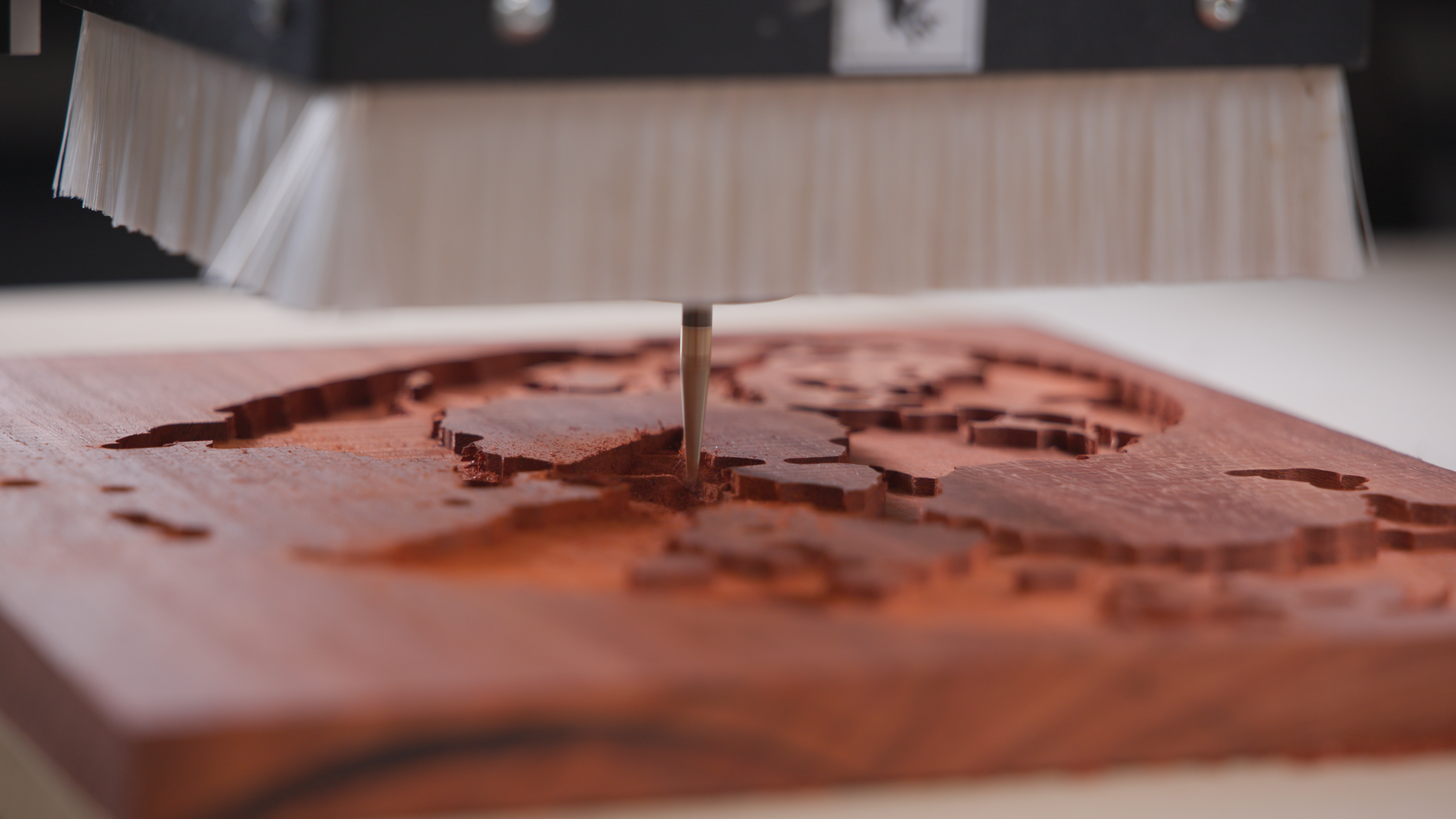
Upcut spiral end mills pull chips up and out of the cut, keeping the zone clear but risking tearout on the top surface. They are a good choice for through cuts and deep pockets. Downcut spirals push chips down and produce a cleaner top surface, but need more attention to chip clearing in deep cuts. Compression bits combine both geometries, producing clean surfaces on both faces simultaneously, and are the preferred choice for sheet goods work where both sides will be visible. V-bits handle lettering, detail carving, and decorative profiles. Ball nose end mills produce smooth curved surfaces on relief carvings and 3D contour work.
Cutting Tool Materials
Carbide is the standard for production wood milling. It holds an edge significantly longer than high-speed steel, handles the abrasive silica content in hardwoods and engineered wood products, and maintains geometry through the higher feed rates production work requires. HSS tooling is cheaper but dulls quickly and is rarely the right choice beyond light occasional use. Diamond-coated tooling is used in high-volume environments running abrasive materials like MDF where carbide wear rates still affect economics at scale.

CNC Feeds and Speeds for Hardwood
The goal with feeds and speeds is not finding a universal setting but understanding the relationship between spindle speed, feed rate, and depth of cut well enough to dial in parameters for each specific material and tool combination.
Spindle Speed
Most CNC routers for wood run between 12,000 and 24,000 RPM. Higher spindle speeds generally produce smoother surfaces but generate more heat if chip load is not sufficient to evacuate material. Harder and denser species benefit from slightly lower RPM than softer ones, and larger diameter bits run at lower RPM than smaller ones to maintain appropriate cutting edge speed.
Feed Rate
Feed rate works with spindle speed to determine chip load, the amount of material each cutting edge removes per revolution. Too little chip load causes the tool to rub rather than cut, generating heat that burns the wood and dulls the bit quickly. Too much overloads the tool. For hardwood, a common starting point is a chip load of 0.005" to 0.010" per tooth per revolution, adjusted from there based on results.
Depth of Cut
Deeper passes reduce cycle time but increase cutting forces, which can cause deflection if the tool or workpiece is not sufficiently rigid. For hardwoods, a conservative starting point is a depth of cut equal to the tool diameter for roughing passes, with a lighter finish pass for final surface quality.
How to Get Clean Cuts When CNC Milling Wood
Clean cuts come from the right combination of tooling, parameters, and setup. Any one working against the others shows up in the finished surface.
Secure Clamping and Workholding
Wood that is not held rigidly will vibrate and shift regardless of how well tooling and parameters are dialed in. Vacuum tables are preferred for sheet goods because they distribute clamping force evenly without obstructions in the cutting path. T-slot clamping, low-profile clamps, and double-sided tape are viable options depending on part geometry. Any movement in the workpiece during a cut is too much movement.
Choose the Right Cutting Parameters
Parameters should be matched to the specific material and tool in use, not copied from a generic chart and left unchanged. Run a test cut on representative stock, evaluate surface quality, check for burning or tearout, and adjust from there. Document the settings that work and build a reference library by material and tool type. That process knowledge compounds over time and pays off on every future job.
Use Proper Dust Collection
Chips and fine dust that accumulate in the cut zone re-enter the cutter on subsequent passes, generating heat and degrading surface quality. In enclosed or pocketed cuts, chip evacuation directly affects finish quality. Beyond the machining impact, hardwood dust is a known respiratory hazard, and fine dust from MDF and engineered products is harder on lungs and collection systems than solid wood. A dust collection setup connected directly to the spindle is the baseline for any serious wood milling operation.
Advantages of CNC Milling Wood
The case for CNC milling over manual woodworking comes down to precision, repeatability, and scale. A CNC router produces the same part to the same dimensions on the hundredth pass as on the first. Complex geometry that would require hours of hand work, relief carvings, detailed joinery, and intricate profiles, is achievable in a fraction of the time once the file is set up and the process is dialed in. For production shops, the economics are straightforward: the machine does not get tired, does not have inconsistent days, and does not introduce the variation that even skilled manual work produces at volume.
Tips for Milling Hardwood With a CNC Machine
Keep tooling sharp. Hardwood is unforgiving of dull bits and shows it immediately in surface finish and edge quality. Use climb cutting for finish passes where surface quality is the priority; it tends to produce cleaner results than conventional cutting in dense species. Condition your lumber before milling: stock that has stabilized to shop humidity produces more consistent results and moves less after cutting. When running a new species for the first time, treat it as a new material with its own requirements rather than assuming settings from a related species will transfer. And document what works. The parameter sets and toolpath strategies that produce good results on a given material are worth keeping.