
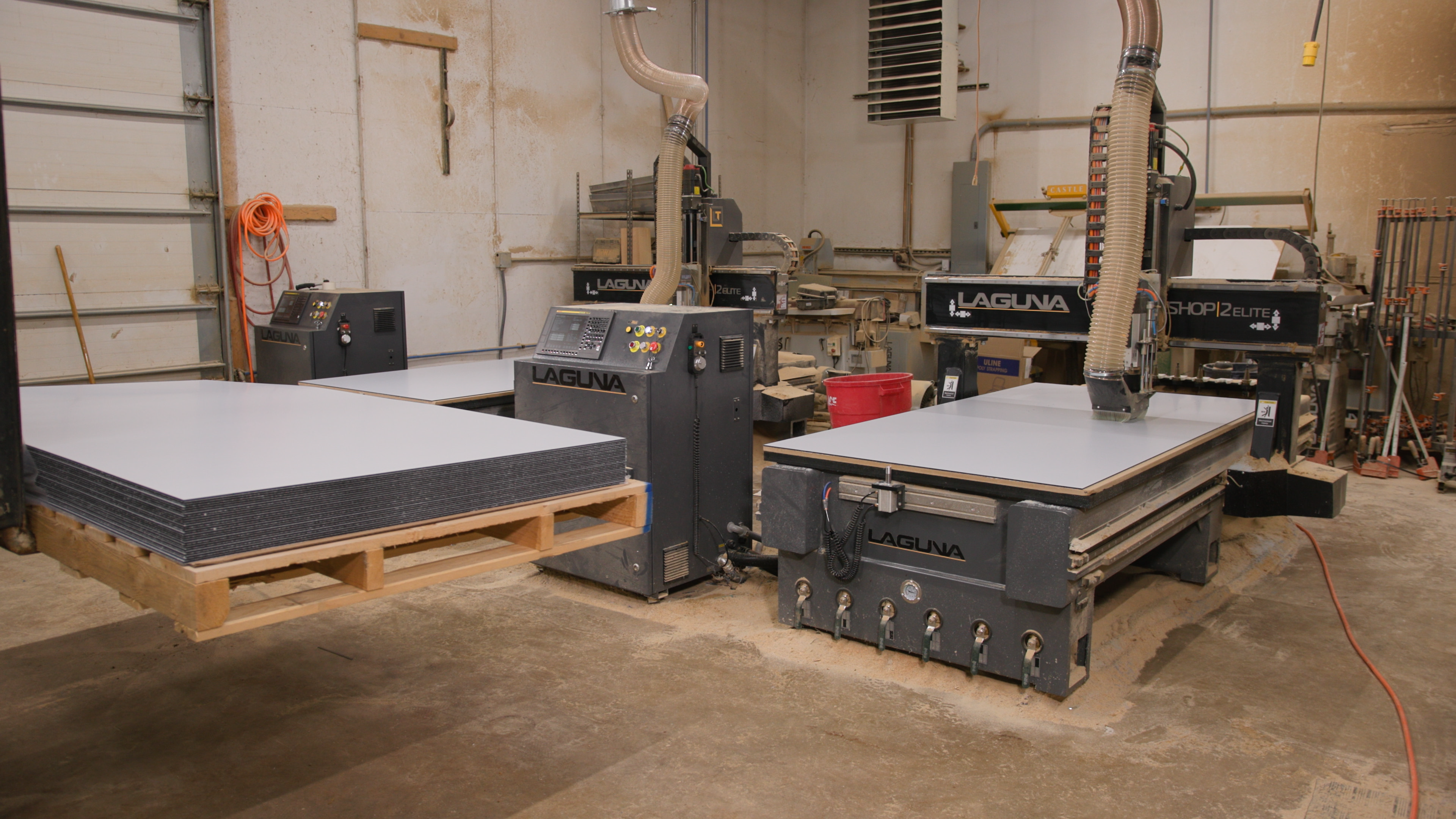
Cabinet shops live and die on sheet yield. The difference between 82 percent and 92 percent utilization across a year of production is real money, measured in pallets of plywood, melamine, and MDF that either go into finished cabinets or end up as scrap on the shop floor. CNC nesting is the tool that decides which side of that line your shop lands on. Done well, nesting shrinks waste, shortens cycle times, and lowers per-part cost. Done poorly, it wastes material, beats up tooling, and slows down the entire production line.
Better nesting is not a single setting. It is the result of balancing software, tooling, part design, and machine constraints in a way that matches how your shop actually runs.
What Cabinet CNC Nesting Is and Why It Matters
Nesting is the process of arranging cabinet parts onto a sheet of material so the CNC can cut them out efficiently. The goal is to fit as many parts as possible onto each sheet while respecting grain direction, tooling clearance, and machine capabilities. Better nesting means more parts per sheet, fewer sheets per job, and less labor spent handling material and scrap.
For a high-volume cabinet shop, a few percentage points of yield translates directly to thousands of dollars in saved material every year, plus reduced cycle time, fewer machine setups, and less downstream cleanup.
The Main Goals of Better CNC Nesting
Good nesting balances several priorities at once: maximum sheet utilization, minimum cycle time, clean part separation, and stable workholding throughout the cut. Pushing one of those too hard can hurt the others. The shops that win on nesting do not chase a single metric. They optimize the whole package.
Start With the Right Information Before Nesting
Nesting software can only optimize what it knows about. Before you run a layout, make sure these inputs are accurate:
- Accurate cabinet part dimensions drawn from your case design software, with all rabbets, dadoes, and holes included.
- Material type, sheet size, and grain direction, particularly important for veneered or melamine panels where grain orientation affects appearance.
- Tool diameter and kerf requirements, including the bit you plan to use and any tool changes mid-job.
- Required spacing between parts so the cutter has room to operate without violating part edges.
- Labeling, machining, and downstream handling needs, including drill operations, edge banding orientation, and how parts will be removed from the table.
Bad inputs produce bad nests. A nest built from rough dimensions or assumed bit size will fail on the machine even if the software said it was optimal.
Nesting Strategies That Improve Sheet Yield
True shape nesting for irregular cabinet parts
True shape nesting uses the actual outline of each part rather than its bounding rectangle. For curved doors, angled gables, or any part that is not strictly rectangular, true shape nesting can dramatically improve yield by fitting parts inside each other's concave areas.
Rotational nesting when grain direction allows
Allowing the software to rotate parts opens up tighter layouts. For materials without a grain requirement (most MDF, melamine, and many plywood applications), rotation is free yield. For grained materials, restrict rotation to the angles that preserve correct grain direction.
Common line cutting and when it makes sense
Common line cutting shares a single kerf between two adjacent parts. It saves material and cut time but requires careful workholding to prevent both parts from moving as the cut completes. It works best for short shared edges on stable materials.
Grouping similar parts for tighter layouts
Parts of similar size and shape nest tighter than mixed-size parts. When job mix allows, group like parts to maximize fit.
Balancing part density with clean part separation
Pushing parts as close together as the math allows looks great on screen and can fail on the machine. Maintain enough margin for the bit, for vacuum hold-down to grip both parts, and for the operator to pull finished parts off the table without damaging them.
How Cabinet Part Design Affects Nesting Efficiency
Part design decisions made upstream affect every nest you build. Standardizing on common sizes, minimizing one-off geometries, and using consistent material thicknesses all improve yield. If your design team consistently produces parts in unusual sizes that do not nest well together, no amount of software optimization will recover the lost yield.
Machine and Tooling Factors That Impact Nesting Performance
Vacuum hold-down and sheet stability
A nest that ignores vacuum zones produces parts that lift mid-cut. Confirm the layout works with your table's vacuum capability, especially for small parts at the edge of the sheet.
Axis speed and machine movement efficiency
A nest that minimizes rapid travel between cuts will finish faster than one with the same yield but longer travel paths. Travel optimization compounds across a full production day.
Tool geometry for clean cuts in panel materials
Compression bits matched to panel thickness produce clean double-sided cuts on melamine and veneered plywood. Match tooling to material, not just to bit life.
Tool life and consistency in nested production
Long nesting runs are hard on tooling. A bit that runs 20 sheets cleanly may start producing torn edges on sheet 25. Track bit life in your scheduling and replace before edge quality drops.
Why tool diameter affects spacing and yield
Larger-diameter bits need more clearance between parts, which reduces yield. Smaller-diameter bits allow tighter nesting but can be more fragile and slower. Pick the largest bit the job tolerates, then nest to that bit's requirements.
Software Features That Help Optimize Cabinet CNC Nesting
Automated vs. manual nesting
Modern nesting software handles most cabinet work without manual intervention. Use automated nesting as the default; reserve manual nesting for unusual layouts where you know something the software does not.
Dynamic nesting and true shape nesting tools
Dynamic nesting recalculates layouts on the fly as you add parts to a job. True shape nesting fits parts to their actual geometry. Both features improve yield meaningfully on jobs with varied part shapes.
Travel path optimization
Most modern post-processors optimize travel between cuts. Confirm the feature is enabled and that it accounts for your actual machine kinematics.
Grain direction controls
For grained materials, lock parts to required grain orientation in the software before nesting. The yield hit is real but predictable, and the alternative is cabinets with mismatched grain on visible faces.
Reporting on sheet usage and scrap
Built-in yield reports show which jobs nest well and which do not. Review them periodically to identify part designs or job mixes that are hurting your overall numbers.
Practical Tips to Improve Cabinet Sheet Yield
A few habits pay back consistently:
Review leftover scrap patterns from past jobs.
If the same shape of drop is leftover repeatedly, your part mix or sheet size may not be matched.
Adjust spacing only as much as tooling safely allows.
Pushing spacing tighter than the bit can handle creates more rework than the yield gain is worth.
Nest similar materials and thicknesses together.
Mixing material types in the same job complicates the cut and limits optimization.
Use consistent sheet sizes where possible.
Standard sheet inventory simplifies nesting and reduces material handling.
Test alternate layouts for high-volume jobs.
A one-time exercise to optimize a repeat job can pay back across every run after.
Reuse offcuts when they are large enough to be practical.
Track and store usable drops so they can be brought back into future nests.
Common Mistakes That Hurt CNC Nesting Efficiency
The biggest mistake is treating nesting as a software-only problem. Layouts that look perfect on screen fail on the machine when they ignore vacuum zones, tooling clearance, or operator handling. Other recurring mistakes include using outdated tool data, ignoring grain direction on visible faces, packing parts so tight that workholding fails, and skipping yield reporting that would highlight problems.
How to Balance Sheet Yield With Shop Efficiency
Maximum yield is not always the right answer. A nest that squeezes one extra part out of a sheet but adds five minutes to cycle time and three minutes to part removal usually loses overall. Track yield, cycle time, and labor together, and optimize for total cost per part rather than yield alone.

A Simple Process for Optimizing Cabinet CNC Nesting
A repeatable workflow keeps results consistent:
Confirm material, grain, and part requirements
Verify the inputs before nesting. Garbage in, garbage out.
Apply the best-fit nesting strategy
Use automated nesting with true shape and rotation where allowed. Add manual adjustments only when the software clearly missed something.
Validate spacing, tooling, and hold-down needs
Check that the layout respects bit clearance, vacuum zones, and any handling requirements before sending it to the machine.
Review sheet utilization and travel efficiency
Look at the yield report and travel path. If either is unexpectedly poor, find out why before running the job.
Test, adjust, and standardize successful layouts
When a nest works well, save it. Repeat jobs should not start from scratch every time.
Final Thoughts
Better cabinet CNC nesting comes from combining smart software settings, accurate design data, tooling awareness, and real-world shop constraints. No single setting will transform your yield. A disciplined process will: accurate inputs, deliberate strategy, validated layouts, and ongoing measurement. The best nesting strategy is the one that consistently improves both sheet yield and overall production efficiency, run after run.
